Read the answer 7th TCCE 2025 · 2026 · Medical imaging AI Can synthetic images help a skin cancer model spot its rarest cancer type? Read the paper 7th TCCE 2025 · 2026 Can synthetic images help a skin cancer model spot its rarest cancer type? The problem Skin cancer datasets are badly imbalanced. In the ISIC 2019 images we studied, squamous cell carcinoma (SCC) has 492 training images against 3,624 for melanoma, so models lean towards the common classes and miss SCC. Our approach MIME puts the usual fixes for imbalance side by side under one protocol on an EfficientNetV2-S backbone: resampling the training data, reweighting the loss, and generating 2,000 synthetic SCC images with a DC-GAN. Each strategy is measured on the same 793-image test set. Key results SCC F1 rose from 11.89% to 53.18% with DC-GAN augmentation, against the linear baselineAccuracy rose from 82.25% to 90.08%, and macro F1 from 60.42% to 82.84%Resampling and loss reweighting reached a macro F1 of 76.52% and 75.70% at best Why it matters For a rare but serious cancer, generating new minority examples did more than reweighting the ones we had. The paper MIME: Multi-strategy Imbalance Mitigation Engine for Skin Cancer Classification Read the paper Close
Read the answer 28th ICCIT 2025 · 2025 Can one security pipeline catch attacks with fewer false alarms and explain each one? Read the paper 28th ICCIT 2025 · 2025 Can one security pipeline catch attacks with fewer false alarms and explain each one? The problem A typical security operations centre can handle more than 10,000 alerts a day, many of them false alarms. Machine-learning detectors help, but an alert that comes with no reason is hard for an analyst to trust or act on. Our approach We built a three-layer framework. A rule engine with adaptive thresholds catches known threats, an ensemble of Random Forest and Isolation Forest looks for both known and unseen attacks, and a fine-tuned Mistral-7B language model turns each flagged alert into a plain-language report mapped to MITRE ATT&CK, with investigation steps and containment actions. Key results 98.7% precision on the CICIDS-2017 and CICIDS-2018 benchmarks, and an 82% reduction in false positives compared to a baseline rule-based systemA false positive rate of 0.021, against 0.048 for SHAP-RF and 0.039 for Hybrid-SVM in the paper's comparisonMean time to respond cut by 58% in simulated analyst workflows Why it matters An alert that arrives with a reason and next steps is easier to trust and quicker to act on. The paper X-SIEM Framework: Integrating Rule-Based, ML, and LLMs for Cyber Threat Intelligence Read the paper Close
Read the answer 12th NSysS 2025 · 2025 Can a malware scanner remember files it has already judged? Read the paper 12th NSysS 2025 · 2025 Can a malware scanner remember files it has already judged? The problem Signature-based detection is efficient against known threats, but it misses zero-day and polymorphic malware that changes its code signature with each iteration. Our approach We call it Behavioral DNA Fingerprinting. A compact neural network classifies Windows executables as benign or malware from 47 static features in the EMBER dataset, and a SHA-256 hash of each file's normalized feature vector is stored as its fingerprint. When a fingerprint is already in the database, the stored label comes back at once and the network is skipped. Key results 91.43% accuracy, 91.66% precision and 91.16% recall on a balanced EMBER test set of 1,494 samplesHigher accuracy than Random Forest (0.892), XGBoost (0.905) and SVM (0.878) in the paper's comparisonMatching accuracy of 1.000 for recurring samples across 4,978 stored fingerprints (exact re-identification, not a test against obfuscation) Why it matters Files a system has already seen can be labelled by a quick lookup, leaving the model for the ones it has not. The paper Fingerprinting Malware Behavior: A Deep Learning Approach Read the paper Close
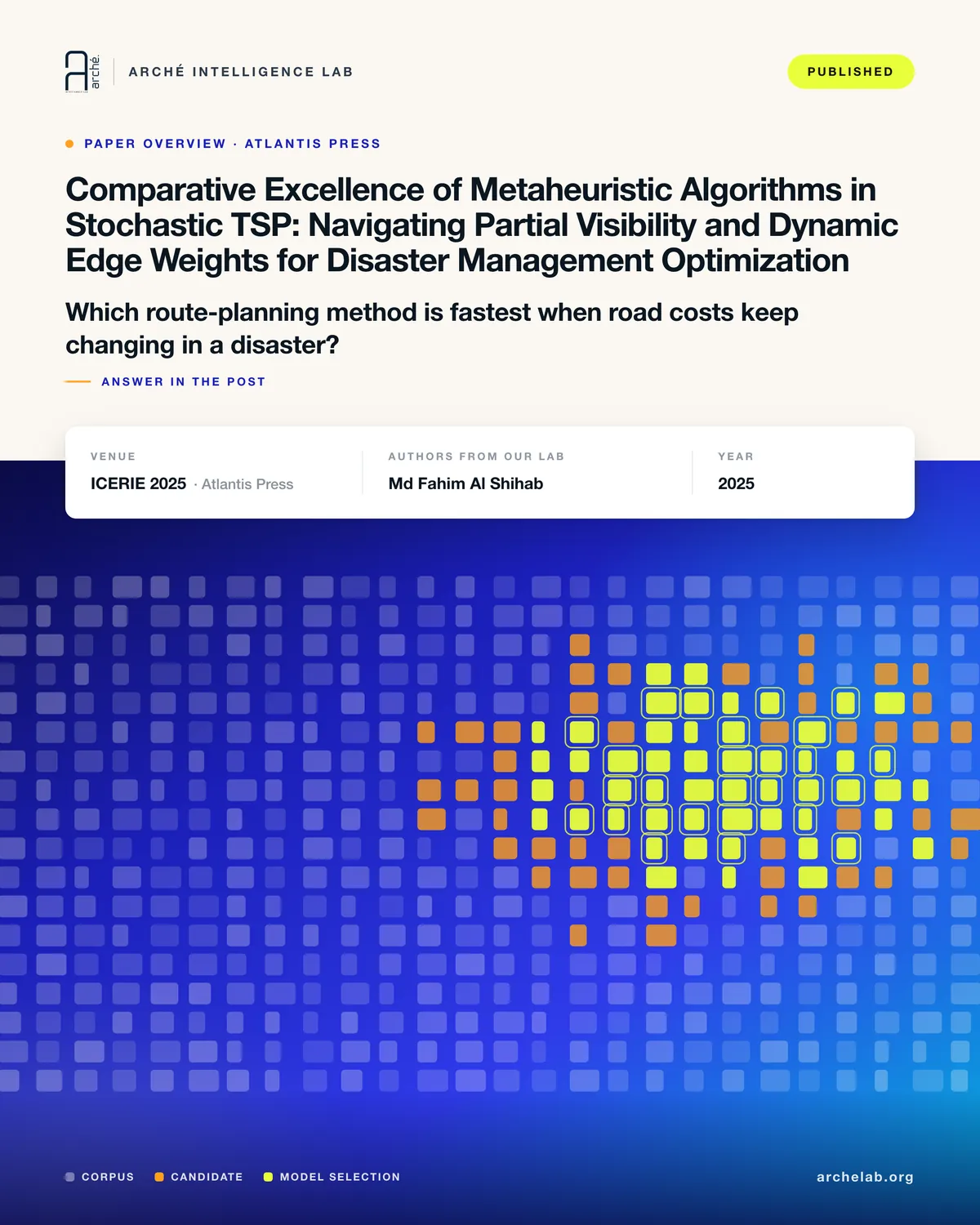
Read the answer 8th ICERIE 2025 · 2025 Which route-planning method is fastest when road costs keep changing in a disaster? Read the paper 8th ICERIE 2025 · 2025 Which route-planning method is fastest when road costs keep changing in a disaster? The problem After a disaster, a rescue vehicle has to plan its route while travel costs shift and only part of the network is visible. This is the stochastic travelling salesman problem, and the answer is needed fast. Our approach We implemented five algorithms in C++: Genetic Algorithm, Ant Colony Optimization, Tabu Search, Simulated Annealing and the Nearest Neighbor Heuristic. We ran them on synthetic four-city test cases with edge weights drawn at runtime, and profiled each one's execution time, instruction count, interrupts and memory. Key results The Nearest Neighbor Heuristic ran in 0.01086 ms, the fastest of the five, against 33 ms for Simulated AnnealingSimulated Annealing was also the only algorithm with interrupts (3), and it used 256 bytes of memory against 64 bytes for the othersOverall, the Nearest Neighbor Heuristic was the most effective of the five, balancing computational efficiency with solution quality, which suits real-time disaster response Why it matters When routes must be planned in real time, knowing what each method costs helps responders pick the right one. The paper Comparative Excellence of Metaheuristic Algorithms in Stochastic TSP: Navigating Partial Visibility and Dynamic Edge Weights for Disaster Management Optimization Read the paper Close
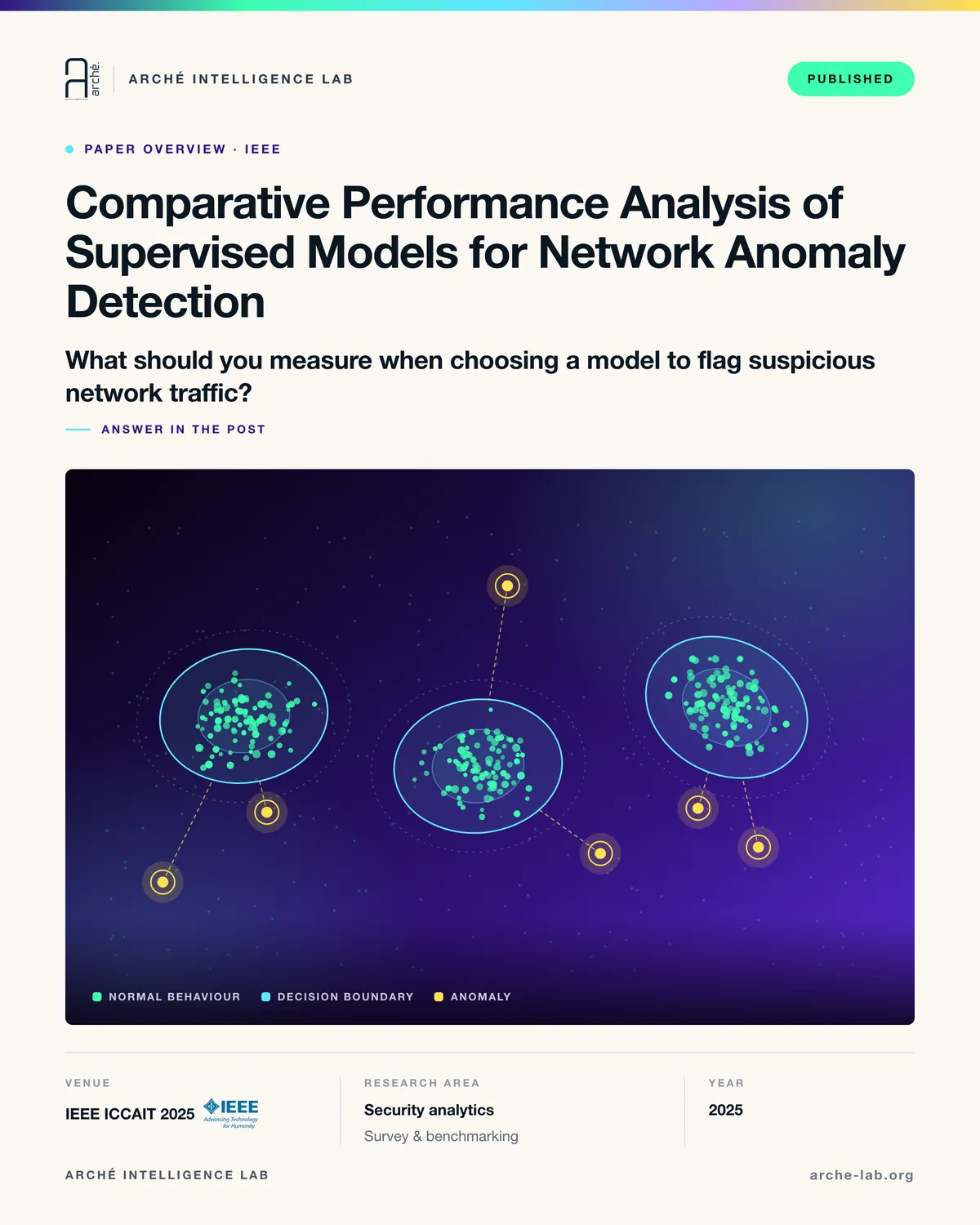
Read the answer IEEE COMPAS 2025 · 2025 What should you measure when choosing a model to flag suspicious network traffic? Read the paper IEEE COMPAS 2025 · 2025 What should you measure when choosing a model to flag suspicious network traffic? The problem Many supervised models can be used to flag intrusions and anomalies in network traffic, which leaves the question of how to compare them fairly. Our approach We compare five supervised classifiers, Random Forest, XGBoost, K-Nearest Neighbors, Support Vector Classifier and Logistic Regression, on the CICIDS2017 dataset. Each is scored on accuracy, precision, recall, F1 and ROC-AUC, and the differences are checked with Friedman, Nemenyi and Wilcoxon tests. Random Forest performed best, with XGBoost and K-Nearest Neighbors close behind. Why it matters It gives teams building intrusion and anomaly detection a side-by-side basis for choosing a model. The paper Comparative Performance Analysis of Supervised Models for Network Anomaly Detection Read the paper Close
Read the answer IEEE ICCAIT 2025 · 2025 Can a city bus watch over passenger safety without sending everything to the cloud? Read the paper IEEE ICCAIT 2025 · 2025 Can a city bus watch over passenger safety without sending everything to the cloud? The problem Monitoring passenger safety on public transit means collecting data about the people on board, and that data has to stay private. Our approach We propose a BusNet-driven IoT architecture that connects on-board sensor networks to edge processing nodes. Inference runs locally on the bus, and data goes to the cloud only selectively. Why it matters It gives transit systems a way to support safety monitoring with privacy built into where the data is processed. The paper A BusNet-Driven IoT Architecture for Enhancing Safety and Privacy in Public Transit Read the paper Close
Read the answer Big Data and Cognitive Computing · 2025 · Natural language processing What still holds back automatic summaries of Bengali text? Read the paper Big Data and Cognitive Computing · 2025 What still holds back automatic summaries of Bengali text? The problem Transformer models now drive text summarization, but Bengali still trails high-resource languages, and the work on it is spread across many models, datasets and metrics. Our approach We review transformer-based models applied to Bengali text summarization in a structured way. The review covers both extractive and abstractive summarization, the benchmark datasets and evaluation metrics in use, and the architectural gaps that remain. Why it matters A single map of models, data and open gaps gives anyone building Bengali summarization a clearer place to start. The paper A Review of the State-of-the-Art Techniques and Analysis of Transformers for Bengali Text Summarization Read the paper Close
Read the answer QPAIN 2025 · 2025 · Medical imaging AI Can one model tell 10 different eye diseases apart? Read the paper QPAIN 2025 · 2025 Can one model tell 10 different eye diseases apart? The problem Earlier eye-disease models were often trained on limited datasets and only a few disease categories, which falls short of what screening in real clinics needs. Our approach VisionOcular uses transfer learning: it starts from a pretrained network, adds an attention mechanism and a custom classifier, and sorts images into 10 eye disease classes from a recently released dataset collected in clinical hospitals. Our EfficientNetV2S-CA model reached 90.87% accuracy, 5.54% above the baseline. Why it matters A single multi-class model points toward screening for several common eye diseases from one image. The paper VisionOcular: Transfer Learning with Self-Attention for Multi-Class Ocular Diagnosis Read the paper Close
Read the answer 2nd NCIM 2025 · 2025 · Medical imaging AI Can a retuned image model classify mammograms accurately and show where it looked? Read the paper 2nd NCIM 2025 · 2025 Can a retuned image model classify mammograms accurately and show where it looked? The problem Early detection matters for breast cancer, but a model that gives a label without showing why is hard to trust. Our approach We modified VGG16, a well-known image network, with custom dropout and dense layers, and trained it on the MIAS mammography dataset of 322 images (189 normal, 133 abnormal). We compared it with five baseline networks and added saliency maps, which highlight the image regions that drove each prediction. Key results 98.03% accuracy for the modified VGG16, against 91.13% for the standard VGG16 in the paper's comparison tableRecall of 98.71% and F1-score of 98.92%, against 80.69% and 89.10% for the standard VGG16 in the same tableThe next best baseline, EfficientNetB0, reached 97.46% accuracy Why it matters A model that is accurate and shows where it looked is easier for a clinician to check. The paper Optimizing Breast Cancer Diagnosis with VGG16 and CNN: An XAI Approach Using Saliency Maps Read the paper Close
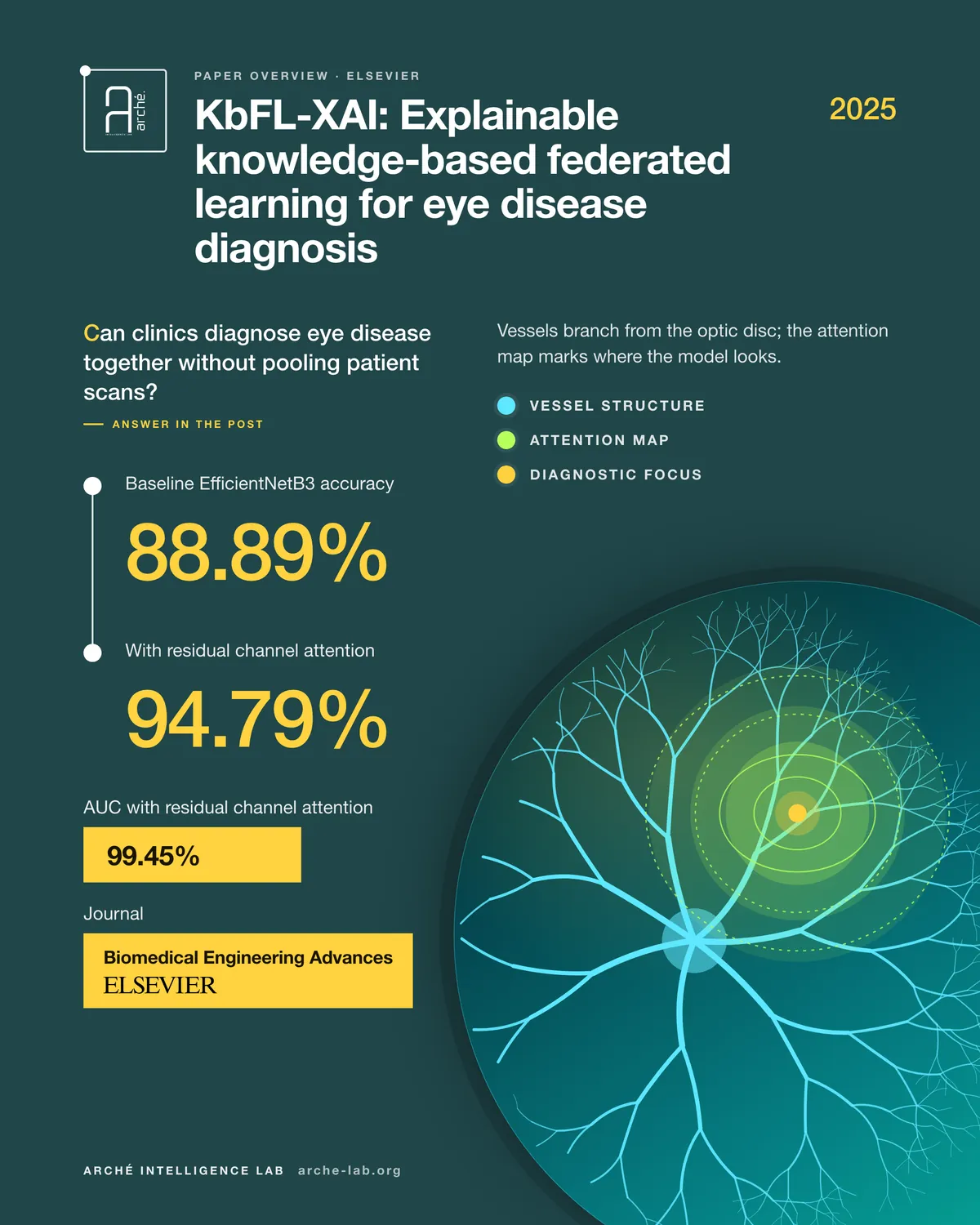
Read the answer Biomedical Engineering Advances · 2025 · Medical imaging AI Can clinics diagnose eye disease together without pooling patient scans? Read the paper Biomedical Engineering Advances · 2025 Can clinics diagnose eye disease together without pooling patient scans? The problem Eye diseases such as cataracts, glaucoma, macular degeneration and diabetic retinopathy seriously impair vision and quality of life, especially in ageing populations, and deep learning can help diagnose them in time. But conventional models need patient images collected in one place, which raises serious concerns about data security and privacy. Our approach KbFL-XAI trains a diagnostic model with federated learning: the data stays with five simulated clients, and a server combines their updates with FedAvg. Each client uses EfficientNetB3 with Residual Channel Attention and a custom classification head, and Grad-CAM shows which retinal regions drive each prediction. Key results 94.79% accuracy and 99.45% AUC across four classes: normal, diabetic retinopathy, cataract and glaucomaUp from 88.89% for the EfficientNetB3 baselineAhead of EfficientNetV2-S (79.91%), MobileNetV2 (77.16%) and three other architectures in the same federated setup Why it matters In a simulated multi-client setup, accurate and explainable eye-disease diagnosis was achieved without patient images leaving their site. The paper KbFL-XAI: Explainable knowledge-based federated learning for eye disease diagnosis Read the paper Close
Read the answer IEEE Access · 2025 · Medical imaging AI Can unlabeled brain scans help classify tumors when few labeled cases exist? Read the paper IEEE Access · 2025 Can unlabeled brain scans help classify tumors when few labeled cases exist? The problem Classifying brain tumors from MRI usually needs large sets of expert-labeled scans, but clinical cohorts with labels are often small. Our approach We tested three self-supervised methods, SimCLR, MoCo and BYOL, on a ResNet-50 backbone, using a new dataset built by combining five public brain MRI datasets. T3SSLNet adds four blocks: image-spectrum enhancement for augmentation, a frozen feature extractor, a projection block for contrastive positive-pair learning, and an unfrozen classification block. After fine-tuning, SimCLR reached the best accuracy, 97.02%. Why it matters It lets unlabeled scans do much of the learning, so tumor classification depends less on large labeled datasets. The paper T3SSLNet: Triple-Method Self-Supervised Learning for Enhanced Brain Tumor Classification in MRI Read the paper Close
Read the answer IEEE Access · 2026 · Computer vision Can clinics train one fungal classifier without sharing a single image? Read the paper IEEE Access · 2026 Can clinics train one fungal classifier without sharing a single image? The problem Fungal infections are diagnosed from microscope images, but many species look alike, and centralised deep learning would mean pooling patient images, which raises privacy concerns. Data spread across sites is also uneven, which makes one shared model hard to train. Our approach MFIFL trains a fungal classifier with federated learning, so raw patient data never leaves each client. Every client runs EFedAttNet, an EfficientNetV2S model with an added attention module. The server then merges the clients with Federated Attention Aggregation (FAA), which aligns what each client's attention focuses on, at a cost of about 50 KB per round for 10 clients. Key results 93.73% test accuracy on DeFungi (9,114 microscope images, five classes), split unevenly across simulated clients+8.92 points over standard FedAvg aggregation (84.81%)Each component adds accuracy: FedAvg 84.81% → with FedAtt attention 91.94% → with FAA 93.73% Why it matters In a simulated multi-site setup, an accurate fungal classifier was trained without any image leaving its site: a step toward clinics collaborating when they cannot pool patient data. The paper MFIFL: Federated Learning With Attention-Based Aggregation for Microscopic Fungal Images Read the paper Close
Read the summary 2nd QPAIN 2026 · 2026 · Medical imaging AI DINO-MIL: An Roi-Based Feature Embedding Framework for Multiple Instance Learning in Breast Mass Classification Read the paper 2nd QPAIN 2026 · 2026 DINO-MIL: An Roi-Based Feature Embedding Framework for Multiple Instance Learning in Breast Mass Classification In brief DINO-MIL classifies mammogram masses as benign or malignant by turning each mammogram into a lesion-centred region, split into a bag of nine 128x128 patches for multiple instance learning. A frozen DINOv2 ViT-L/14 extracts patch features, which are pooled, reduced with PCA, balanced with SMOTE and classified by an RBF SVM. On 257 DMID mammograms with five-fold cross-validation it reached 90.4% accuracy and an AUC of 0.913. The paper DINO-MIL: An Roi-Based Feature Embedding Framework for Multiple Instance Learning in Breast Mass Classification Read the paper Close
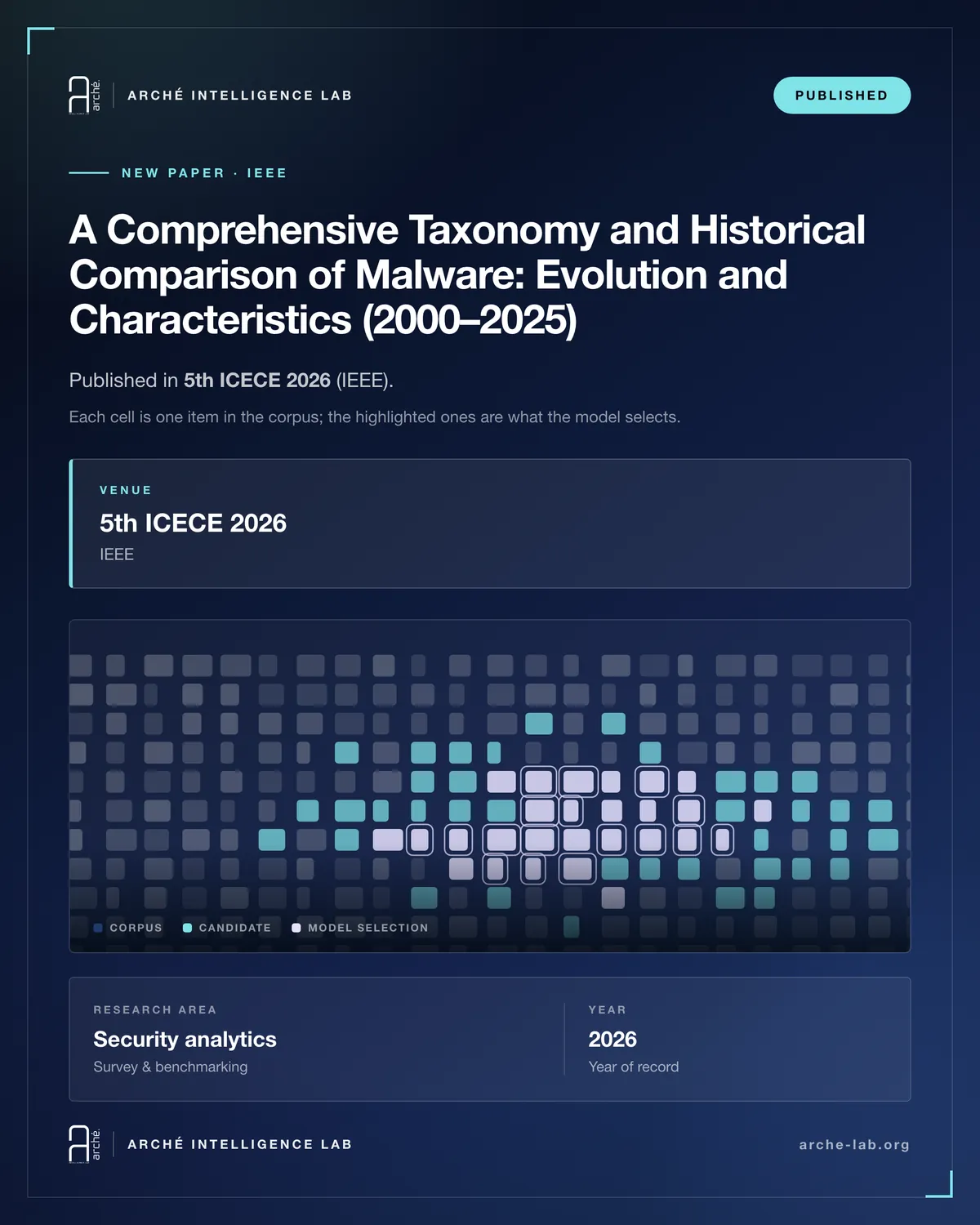
Read the summary 5th ICECTE 2026 · 2026 A Comprehensive Taxonomy and Historical Comparison of Malware: Evolution and Characteristics (2000-2025) Read the paper 5th ICECTE 2026 · 2026 A Comprehensive Taxonomy and Historical Comparison of Malware: Evolution and Characteristics (2000-2025) In brief This paper traces how malware changed between 2000 and 2025, from outbreaks driven by notoriety to stealthy, profit-driven and service-based operations. It separates traditional families such as viruses, worms, trojans and ransomware from newer types such as botnets, fileless malware and cryptojackers, by how they spread and what they aim to do. Based on over 150 documented malware families and incidents, it notes a shift to finance-first malware after 2013. The paper A Comprehensive Taxonomy and Historical Comparison of Malware: Evolution and Characteristics (2000-2025) Read the paper Close
Read the summary Healthcare Technology Letters · 2026 · Medical imaging AI OpthaNet: Attention-Integrated Architecture for High-Precision Multi-Class Ophthalmic Image Classification Read the paper Healthcare Technology Letters · 2026 OpthaNet: Attention-Integrated Architecture for High-Precision Multi-Class Ophthalmic Image Classification In brief The study compares EfficientNetB3, MobileNetV2 and a vision transformer for classifying cataract, diabetic retinopathy and glaucoma from fundus images. The two CNNs gain an attention-based feature refinement module and a custom classifier head called OpthaHead, while the transformer is simplified with a META customization. The modified EfficientNetB3 reached 96.04% accuracy, 10.84% above its baseline, and the transformer improved by more than 18%. The paper OpthaNet: Attention-Integrated Architecture for High-Precision Multi-Class Ophthalmic Image Classification Read the paper Close